 GP PRINTWORKS
Custom printed promotional lighters
GP PRINTWORKS
Custom printed promotional lighters
GP PRINTWORKS
Custom printed promotional lighters
GP PRINTWORKS
Custom printed promotional lighters

Trade and wholesale information only. Minimum order 300 units. Please confirm you are 18 or older to continue.
This page is an editorial and informational resource about the bulk decoration of promotional lighters — imprint methods, artwork specifications, print colours, order quantities and freight requirements. It is written for business buyers, event organisers and promotional product distributors.
Lighters are age-restricted articles in many jurisdictions and are sold to adults aged 18 and over only. Lighters are a flammable consumer product: keep away from children, keep away from heat and open flame, and always follow the safety text moulded onto the article and printed on the carton.
BIC® is a registered trademark of Société BIC S.A. It is referred to on this page for product identification purposes only.
Print area, silkscreen decoration, and how one-side and two-side printing differ in practice.
Body colours, stock ink colours, custom PMS matching, and which combinations are restricted.
Minimum type size, line weight and negative space — the numbers that decide whether art prints cleanly.
Production windows, hazmat ground shipping, signature requirements and commercial delivery rules.
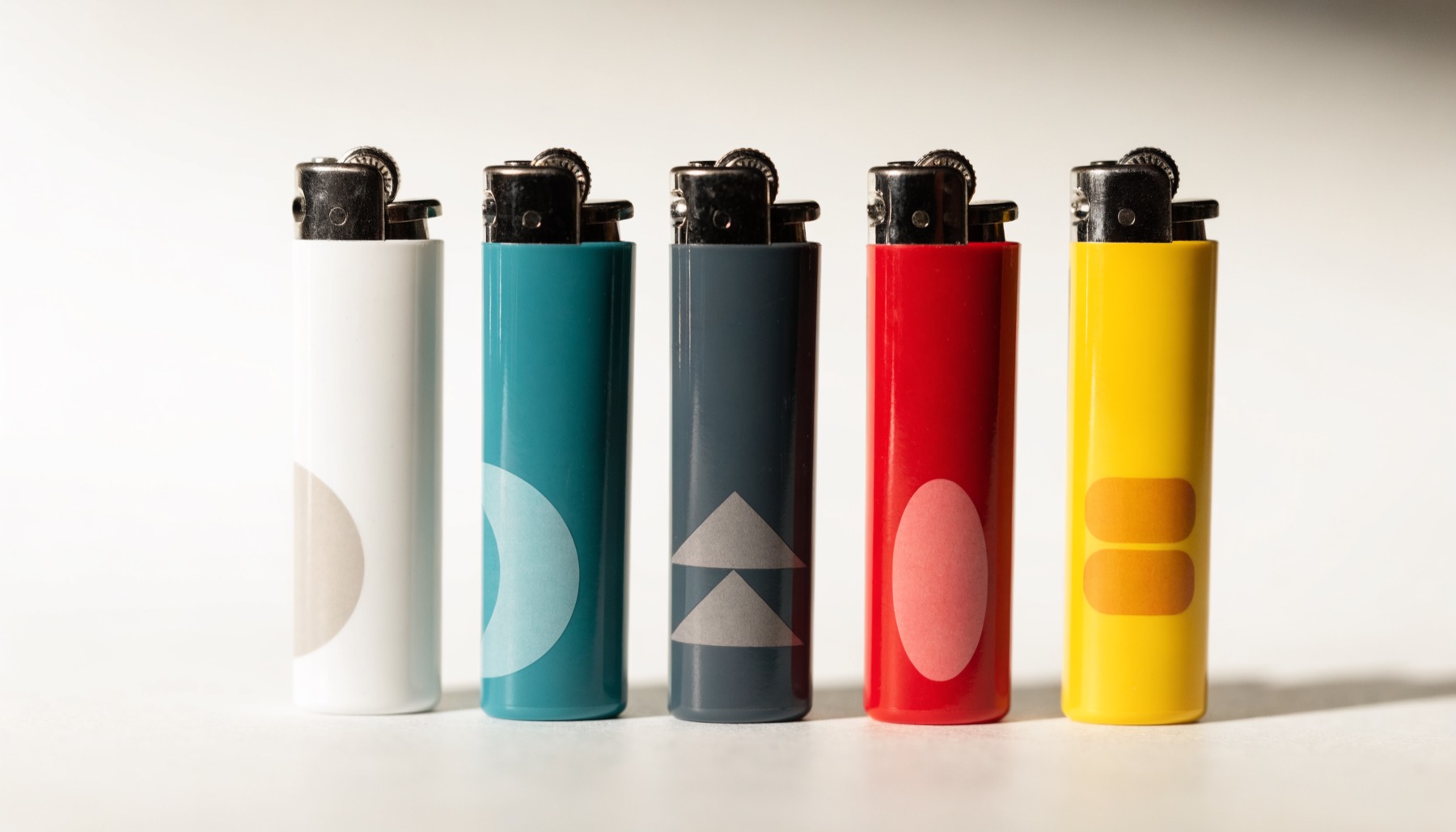
A printed lighter is one of the few promotional items that people keep, carry and lend out. That last part matters more than it sounds: a lighter changes hands constantly, which means a single unit is seen by far more people than the one who received it. It is small, cheap per unit and — unlike a flyer or a tote bag — genuinely useful, so it does not get thrown away.
This guide covers what actually determines the outcome of a bulk lighter order: the imprint area, the number of print colours, the artwork specifications, the minimum quantities, and the freight rules that apply because lighters ship as hazardous materials. It is written for buyers placing trade orders, not for consumers.
Most bulk lighter programmes are built around the BIC® Maxi — the full-size classic — for three reasons. First, consistency: it is a mass-produced article with tight tolerances, so a run of 10,000 pieces looks the same at the end as it did at the start. Second, longevity: the Maxi is rated to roughly 3,000 lights, so a recipient keeps it in a pocket or a drawer for months rather than days. Third, decoration: the body is designed to take a silkscreen imprint cleanly, which is not true of every lighter on the market.
Units printed for the North American market are decorated in the United States — at BIC's facility in Pittston, Pennsylvania — rather than imported pre-printed. In practice, that shortens the freight leg and keeps a "Made in USA" line available for buyers who need it.
The decoration method is silkscreen: ink is pushed through a mesh screen onto the body of the lighter, one screen per colour. The usable print area on a Maxi is 0.75″ × 2″ (roughly 19 × 50 mm). That is a small canvas, and it is the single most common reason artwork has to be redrawn — a logo that reads perfectly on a website often collapses at this size.
There is one trade-off worth knowing before you design a two-side layout. Every lighter ships with a required federal safety warning label applied to the second side. It peels off easily by hand, but it does sit over part of the back imprint area while the product is in the box. Keep anything critical — a QR code, small print, a URL — clear of the area the label covers, or accept that the recipient will peel it before the back becomes fully legible.
On dark bodies, particularly black, a single ink pass can look muted. Printing the same ink twice in the same position gives a noticeably denser, brighter result. It is billed as an additional imprint colour, so factor it in when you are comparing quotes on a black-body run.
Two colour decisions are made independently: the colour of the lighter itself, and the colour or colours of the ink printed on it.
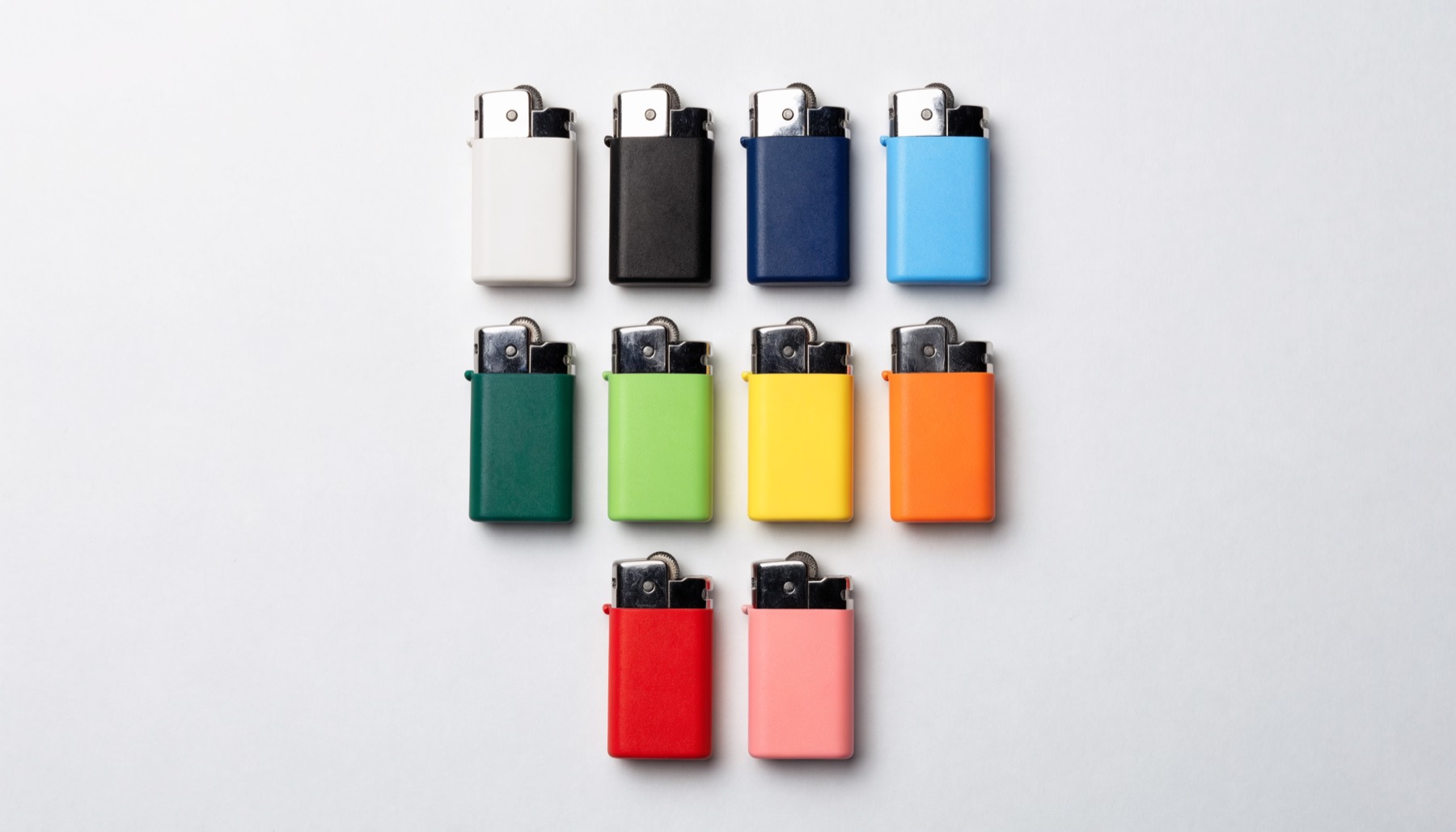
The standard range is ten: white, black, dark blue (287c), light blue (2985c), dark green (335c), lime green (375c), yellow (Pantone Yellow C), orange (1585c), red (186c) and pink (Rhodamine Red C).
A useful and frequently missed point about pricing: the factory prices a production by artwork and ink colour, not by body colour. As long as the artwork and the print colours stay identical, you can split the run across as many body colours as you like — in increments of 300 — and still receive the volume price for the total. A 2,400-piece order can therefore be eight different body colours rather than one, at no extra cost per unit.
Both are available in multiples of 600 and carry a one-time sorting charge that covers the whole order, not each box.
One stock ink colour is included in the base price. The standard stock range runs to roughly two dozen colours — white, black, orange 172, red 186, maroon 202, burgundy 208, cream 1345, lemon 114, athletic gold 116, teal 327, dark teal 316, magenta 205, forest green 341, process blue, royal blue 293, reflex blue, navy blue 281, pink 211, green 355, purple 2587, brown 1545, charcoal grey 424, metallic gold 872 and metallic silver 877. Additional colours are priced per colour, per side, to a maximum of four per side.
If your brand colour is not in the stock range, a custom PMS match from the Pantone Solid Coated book is available for a flat per-colour charge. For a brand-critical colour it is almost always worth it; for a one-off giveaway the nearest stock colour usually is not worth the surcharge.
White lighters are limited to one or two imprint colours or locations. This is a manufacturing constraint, not a commercial one — flint dust accumulates visibly on a white body during additional print passes. Every other body colour accepts the full one to four colours, front and back.
Silkscreen at this scale has hard physical limits. Art that violates them does not print badly — it fills in, closes up, or drops out entirely. Four figures are worth memorising:
| Specification | Minimum | Why it matters |
|---|---|---|
| Type size | 6 pt | Smaller type closes up as ink spreads on the curved body. |
| Line thickness | 0.5 pt | Thinner strokes break up or disappear entirely. |
| Negative space | 0.7 pt | Gaps narrower than this fill in, turning detail into a solid block. |
| Print colours | 4 per side, max | From the Pantone Solid Coated colourbook; one screen per colour. |
Supply artwork as vector where possible. Raster files can work, but only at high resolution and with clean, well-separated edges.
Lighters are sold by the case. The standard minimum is one box of 300 pieces, and price steps down at fixed quantity breaks from there. The published tiers run 300 · 600 · 1,200 · 2,400 · 5,100 · 10,200 · 21,000 · 50,100.
Two things drive the per-unit figure: the quantity tier, and the number of imprint colours per side. Each additional colour adds a fixed amount per unit that does not scale away with volume — so a four-colour design costs the same premium at 50,000 pieces as it does at 300. Print plate setup is typically included rather than billed separately, which is worth confirming on any comparison quote.
A brewery ordering 2,400 lighters in a two-colour front print, split across four body colours (600 of each), pays the 2,400 volume tier — not four separate 600 tiers — because the artwork and ink colours are identical across all four. That is the single largest avoidable cost mistake in this category.
This is where lighter orders differ most from ordinary promotional goods, and where in-hands dates get missed.
| Stage | Typical window | Notes |
|---|---|---|
| Production | 2–4 weeks | Allow 4–6 weeks on orders above 10,000 pieces. |
| Rush production | 5 business days | Available for a flat surcharge; ask before assuming you need it. |
| Ground, USA | 1–5 business days | Hazmat ground service. Signature required on delivery. |
| Ground, Canada | 5–10 business days | Ships from the Toronto hub; transit varies by province. |
The item works best where people gather and where a small useful object gets passed around: bars, breweries and taprooms; festivals, trade shows and conferences; hotels and restaurants; hardware, outdoor and camping retail; candle and home-fragrance brands; and promotional distributors buying on behalf of any of the above. Many buyers also resell them at the counter rather than giving them away — at these unit costs the margin is straightforward.
Whichever route you take, the design principle is the same: the mark has to be legible in the half-second someone glances down while using it. Everything else on the specification sheet is in service of that.
Get those nine right and a lighter programme is one of the least complicated things a brand can put its name on — and one of the few that people keep.
Learn how we work, what we decorate, and how to reach the team with a question about a specification or a deadline.
GP Printworks is a promotional products decorator based in Washington State. We publish this editorial resource because the questions that arrive with a bulk lighter enquiry are almost always the same ones — print area, colour counts, artwork minimums and freight rules — and they are easier to answer once, properly, than one email at a time.